Wednesday, March 30, 2011

Social Capital and Trust

From the Better Together website's article about social capital:
 "When a group of neighbors informally keep an eye on one another's homes, that's social capital in action. When a tightly knit community of Hassidic Jews trade diamonds without having to test each gem for purity, that's social capital in action. Barn-raising on the frontier was social capital in action, and so too are e-mail exchanges among members of a cancer support group. Social capital can be found in friendship networks, neighborhoods, churches, schools, bridge clubs, civic associations, and even bars. "
I think that this kind of social capital is very evident on St. Olaf's campus.  We have friendship networks that exist because of sports teams, music groups, even classes.  The students look out for each other, just like some neighbors do for each other.  We have a built in system of trust -- we get to leave our bags and books around and trust that no one will steal them.  This is such a privilege. Many of my friends and larger universities are appalled that we have such a trust system. They say that they could never leave any of their personal belongings unattended, much less their dorm room unlocked.  Even though my roommate and I lock our doors every time we leave, I know of at least 4 rooms on my floor that are never locked. All of this is because we have this system of trust.  Trust has built large social capital on this St. Olaf campus, and it is interesting to think what the world would be like if there was a trust system in every country like there is on our campus. 

Tuesday, March 29, 2011

Walmart and Women's Equality

I found this article on the Washington Post website about a massive Walmart discrimination suit against women:
http://www.washingtonpost.com/politics/justices-question-next-step-for-massive-wal-mart-discrimination-suit/2011/03/29/AFToRZvB_story.html


       It reminded me of all our discussions about equality, especially now that we have a group investigating a women's voluntary association.  This section of the article really stood out to me: 
"Joseph M. Sellers, arguing on behalf of the women, said it didn’t matter if Wal-mart had an official policy of nondiscrimination if it left its managers free to carry out a “corporate culture” of paying women less and promoting more men to managerial positions."
      Just because something is culturally acceptable, does that make it right?  Think back to slavery...it was "American culture" to have and abuse slaves.  Now this guy is saying its "corporate culture" to discriminate against women.  These two issues can kind of be paralleled!  This is so wrong, and it is my hope that the Supreme Court justices keep questioning this case. 

Monday, March 28, 2011

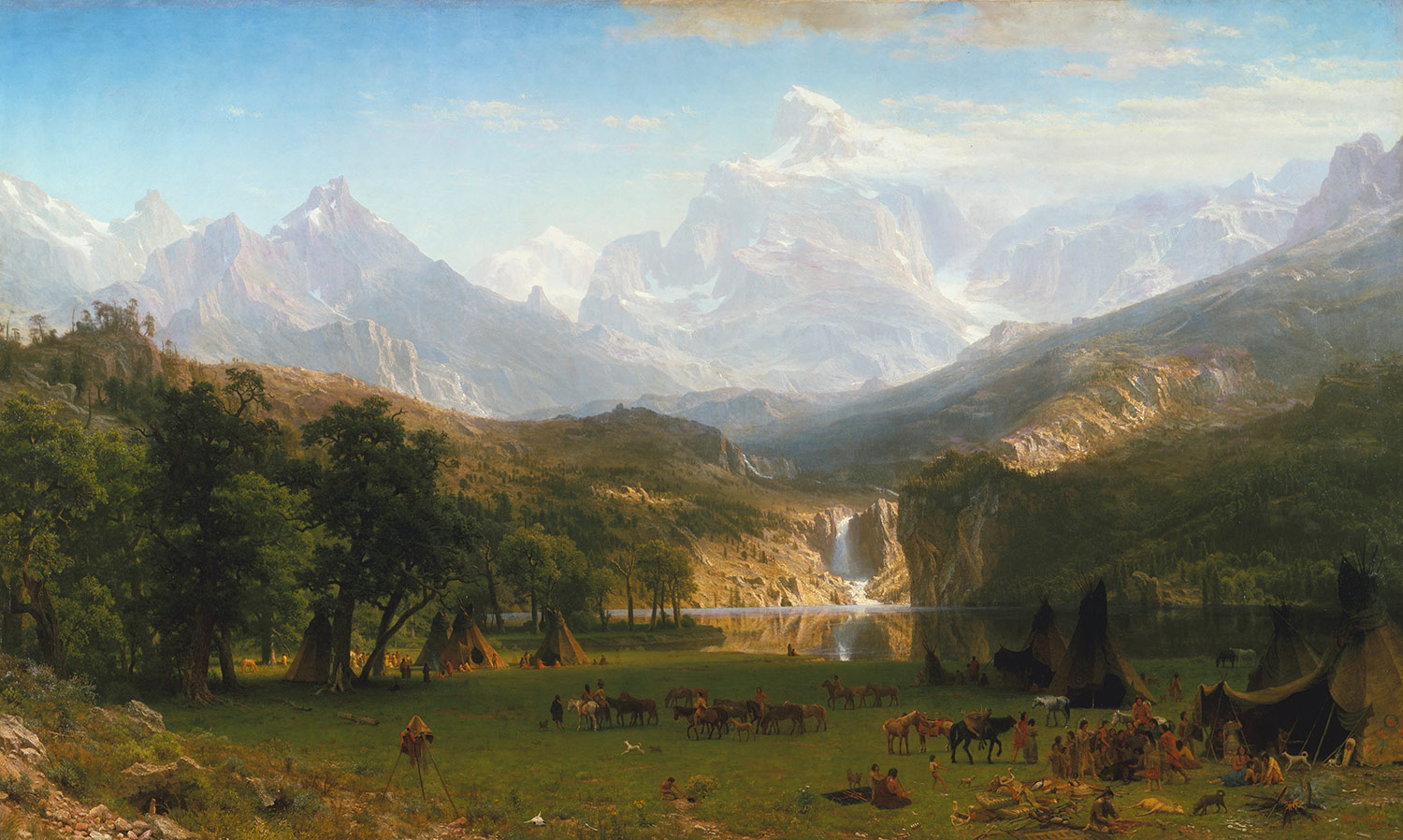
American Nature and Art

          On the UVA site on Tocqueville it says, "He (Tocqueville) wrote in Democracy in America: 'Europeans think a lot about the wild, open spaces of America, but the Americns themselves hardly give them a thought.'"
This is thoroughly evident from looking at the works for the Hudson River School; the majority of the art is of nature.  So much artistry revolves around painting landscapes...and I've witnessed this, in the summer at lakes - seeing painters creating their interpretation of the nature around them.  The following are a few pieces that I really liked because of their representation of nature; they seem to portray nature as a safe haven -- a wonderful, peaceful place to be:

Monday, March 14, 2011

Stout's "Blessed are the Organized" and the Objectives of an Organization

Stout defines what internal organizing is aimed at in two objectives:
       "The first is to get people within a given institution talking with each other about their concerns.  In the case of a church this would mean hundreds of individual conversations and small gatherings -- called 'one-on-ones' and 'house meetings,' respectively -- among church members.  The second objective is to identify and cultivate leaders from within.  These leaders represent their institutions in the citizens' organization and in the broader forum of public discussion" (2).
    These objectives seem to echo what De Tocqueville thought the purpose of voluntary associations were. Small gatherings and leaders should emerge from organizations in order to better society.  Stout emphasizes that each organization needs organization (in order to function well)!  Could it possibly be that the absence of leaders within these organizations is what has contributed to Putnam's claim that social capital has declined?  Leaders can help bring all issues to attention instead of just one.  Stout writes, "Broad-based organizing differs from social movement organizing in that it does not restrict itself to a single issue and instead takes up different issues over time in response to concerns expressed by citizens" (8).   Organization within an association is key to the continuing functionality of that group.  Without organization, issues do not get resolved and the purpose of the group is lost.  Perhaps lack of organization is one of the roots of the diminished social capital we have today.

Sunday, March 13, 2011

Durlauf's Review of Putam

           In Steven Durlauf's review of Putnam's "Bowling Alone", he criticizes Putnam's analysis of why social capital has declined and that his essay reflects many of the strengths and weaknesses of the social capital literature.  While Putnam succeeds in describing facts concerning community life in America, his writing suffers from many of the conceptual problems and empirical weaknesses that have plagued the social capital literature (Durlauf).    While Durlauf acknowledges that "Bowling Alone" does a great deal to emphasize the decline in social capital over the last few decades,  it disappoints when judged from the perspective of rigor or analytical depth.  Here is an excerpt from my response that I have written for Monday: 
          There is also question as to whether the decline in voluntary organizations and social relations such as marriage really measure the declines in social capital.  Social pressure plays a large role in why people join certain organizations, such as the Cub Scouts; boys want to prove to be “one of the boys” (Durlauf).  Similarly, rising divorce rates should not be treated as evidence of reduced family social capital and instead treated as a suggestion that there is less social pressure against divorces now than there used to be. Putnam falls short in his study about less involvement in social capital.  In short, “Bowling Alone”  fails to deeply analyze the real causes of a social capital decline, and demonstrates the sloppiness and ambiguity that permeates through much of the social capital literature today. 

Thursday, March 10, 2011

Paying Attention

         Robert Bellah's Democracy Means Paying Attention discusses the importance of citizens paying attention and being aware of what is going on in their democracy.  If citizens are unaware of the issues in their democracy, it is hard to make the democracy function properly; they need to pay attention to the important matters.  Bellah writes, "One way of defining democracy would be to call it a political system in which people actively attend to what is significant" (273).
          Has America's attention to democracy decreased over the years?  From what we've been discussing in class about how less people vote, less people inform themselves about the candidates, and less people participate in voluntary associations, the answer seems to be yes.  Does this make America a bad society?  Is America not as "good" of a nation as it was in the 1800s when De Tocqueville visited?  Bellah discusses these questions when he writes, "It is doubtful whether attention has priority in America today.  Much of our current politics seems to be designed to distract us from what is important and seduce us into fantasies that all is well.  Worse, these politics offer solutions that only increase our distraction...Attending means to concern ourselves with the larger meaning of things in the longer run, rather than with short-term payoffs.  The pursuit of immediate pleasure, or the promise of immediate pleasure, is the essence of distraction.  A good society is one in which attention takes precedence over distraction" (273).

Tuesday, March 8, 2011

A Downturn in Civic Engagement

What is Putnam saying in "Bowling Alone"?
        Putnam's focus is on how the participation of Americans in civic engagement (voluntary associations, etc), has largely decreased since de Tocqueville was in America in 1830.  De Tocqueville was impressed at  how well voluntary associations helped our nation grow and how it helped democracy work in a civil way.  Yet now, less Americans are participating in these voluntary associations than before, and democracy is not working as well as it was in the 1800s.  Putnam's proposed reason for this is portrayed when he writes, "In America, at least, there is reason to suspect that this democratic disarray may be linked to a broad and continuing erosion of civic engagement that began a quarter-century ago."
      He uses the example of bowling leagues to further prove his point. "The most whimsical yet discomfiting bit of evidence of social disengagement in contemporary America that I have discovered is this: more Americans are bowling today than ever before, but bowling in organized leagues has plummeted in the last decade or so...The broader social significance, however, lies in the social interaction and even occasionally civic conversations over beer and pizza that solo bowlers forgo."  So, it seems as though Americans are still doing some of these things that they would be doing in an association...bowling, volunteering, educating themselves, etc; but they are doing them alone.  They key to democracy is participation...the citizens of America need to feel as though they are a part of a community.  This aspect disappears when everyone does things on their own, instead of in voluntary associations.  Putnam emphasizes that America should concern itself with reactivating the participation of its citizens in voluntary associations in order to preserve the well-being of democracy in America.